
i love power
on jill magid for artforum

I actually don’t *love* power, but I do love Jill Magid. I first encountered her work on a trip to Dallas’s The Warehouse, where I saw some of her later works with NFTs. Her conceptual art consistently interrogates the character and shape of power today, exposing its bizarre eccentricities through elaborate seductions. She’s like the Kafka of contemporary art, but more feminist.
I wrote about her latest exhibition at Various Small Fires for Artforum.
xx c
Jill Magid loves power. Her artwork seduces authority with the dogged persistence of a skilled flirt, following the rules of engagement so precisely that she seems to both reveal and subvert the aims of her suitor. She courted a policeman in the New York City subway system by asking repeatedly to be body searched (Lincoln Ocean Victor Eddy, 2007) and wrote love letters to British cops requesting footage of herself caught by citywide surveillance cameras (Evidence Locker, 2004). Magid’s “Heart of a Citizen” at Various Small Fires (VSF) was less amorous than her prior work, but she characteristically toed the line between complicity and critique, this time turning her gaze to an unlikely subject: an unexpected bid for US Congress in California’s Fortieth District by Esther Kim Varet, VSF’s proprietor who hopes to oust Republican incumbent Young Kim in the 2026 midterm elections.
In the gallery’s outdoor courtyard lay The Rose Garden, 2025, a set of twelve small, polished concrete casts of what viewers were told was “the artist’s heart” scattered across the black-gravel field. Their small, haunting forms appeared as though sacrificed on the altar of Varet’s gallery—and of her campaign, much of which utilizes the gallery as an unofficial platform (VSF’s Instagram bio includes a link to Varet’s campaign donation page). Artistic re-creations of Magid’s body are one of her hallmarks, a way of self-consciously performing her own morbid subservience to art-world power players. In her most notorious work to date, Auto Portrait Pending, 2005, a ring with an empty setting awaits the jewel that will be formed from Magid’s cremated remains, after which her dead body will function like equity, since it could be presumed that the work would end up in a private collection. Magid’s concrete hearts were arranged in the shadow of Stenographer’s Note: [At this point, a gust of wind rustled the trees of the Rose Garden.], 2025, a fifteen-foot neon sign with the bracketed phrase rendered in a glowing red scrawl. The text, derived from notes taken at a White House Rose Garden briefing, is a poetic disruption written into the official record of a government proceeding—an apt corollary for Magid’s own artistic take on Varet’s campaign.
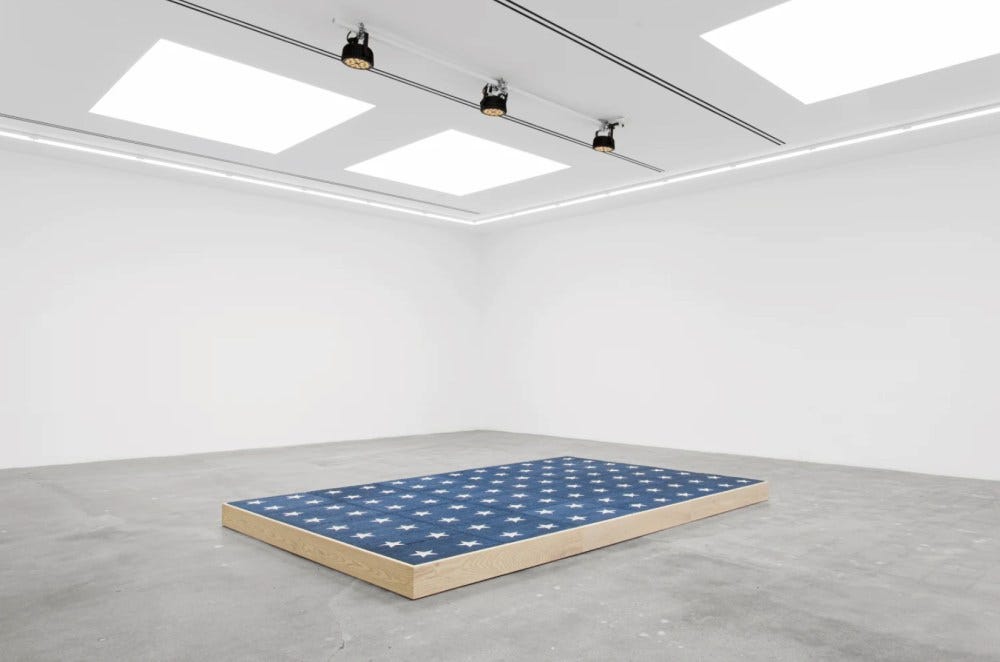
The only artwork inside the gallery was The Platform (US General Elections, 2026), 2025, a multifaceted Conceptual piece that reveals the tricky connections between Varet’s campaign and her gallery—though it does not overtly critique them. Part of the artwork, a floor-based platform modeled after the White House Briefing Room’s starry blue carpet, served as a stage for two campaign events, one of which occurred during Magid’s exhibition opening. During the event, Varet delivered an emphatic stump speech replete with oddly vague promises. “We will make a difference,” she emphasized multiple times, offering no concrete suggestions—to a roomful of clients, many of whom presumably doubled as campaign donors. The sincere speech, enveloped by the distancing chill of the gallery, came off as melodramatic and vacuous—an unwitting embodiment of how contemporary politics, like contemporary art, often performs its own inadvertent satire.
In a display case in a back room, a series of documents that are considered part of The Platform provided context for the artwork and clarified the bureaucracies involved in its dual functioning as a part of Varet’s campaign and Magid’s exhibition. A collector’s note detailing the official donation of The Platform to Varet’s campaign sat beside a legal agreement between two Esther Kim Varets, one identified as “Esther Kim Varet, candidate” and the other as “Esther Kim Varet, CEO.” Magid’s strict adherence to Federal Election Commission regulations—and her choice to exhibit these records—highlights how easily and legally American democracy can be used to support business interests, and vice versa, sometimes to near-comic effect. Magid negotiates these Kafkaesque dynamics in her letters to Varet, also on display, that maintain the distanced aloofness of a court deposition. “The Platform,” she judiciously writes, “was constructed not only to support speech, but to hold its contradictions.”
At points, Magid’s exhibition seemed like it brought a knife to a gunfight: Varet is a long shot to upset Kim, and she is far from the first person to turn their company into a campaign headquarters or to make their run for office into an economic-growth opportunity (President Donald Trump, for example, has more than doubled his wealth in 2025, according to some reports). Magid’s unwillingness to explicitly comment on Varet’s controversial campaign, though, felt subversive in a climate that rewards outspoken public display. Her quieter route navigated a tantalizing space between resistance and appeasement, avoiding the overt endorsement or critique that might alienate—or gratify—either Varet or her audience. After all, that’s just good business—I mean, politics.